Originally published in Business Green on 8th April 2026
By Tessa Clarke, Co-Founder & CEO, Olio

Twice in the past week, people quoted Upton Sinclair’s immortal words to me: “It is difficult to get a man to understand something when his salary depends on his not understanding it.”
The first time was about a presenter on an outrage-driven radio station flatly refusing to acknowledge the climate crisis as he demanded we “drill baby, drill.”
The second was about the mounting scientific evidence of microplastics’ devastating health impacts, and the industry’s studied failure to respond.
Two different topics, but a shared underlying dynamic: the wilful failure to understand, because understanding would demand change. And change might threaten profit.
But right now, I sense something may be shifting; our luxury of denial may be under attack. Because as reality starts to bite, denial becomes increasingly difficult to sustain.
The moment the abstract becomes urgent
It’s undeniable that we’re living through a period of extraordinary geopolitical instability. Supply chains that once seemed invisible and invincible are now fragile. The Strait of Hormuz – through which 20% of the world’s oil and 30% of fertiliser passes every year – is under massive pressure. Heating oil, food production, and global logistics are all at risk.
So a question that seemed unfashionably idealistic a few years ago: “what if we made the most of what we already have?”, has quickly become the most practical question in the room.
And nowhere is this truer than in food. Globally, we waste a third of the food we produce each year. That waste is responsible for 10% of all greenhouse gas emissions (which is five times more than aviation and more than the entire fashion industry). A quarter of our freshwater is used to grow food that never gets eaten, made all the more alarming by the UN’s recent warning that many parts of the world are now “water bankrupt.” All this comes with a hefty price tag too: we waste over $1 trillion worth of food each year.
As we struggle to figure out how to feed a global population of 10 billion people, it’s clear that food waste is not a niche environmental concern.
It’s one of the most pressing economic, geopolitical, and humanitarian challenges of our time.
And in a world of tightening constraints, food waste is no longer a ‘necessary by-product’ of operations: it’s existential.
Yet, the dominant response from industry has been… silence. Or worse, the Upton Sinclair instinct: don’t understand what your salary depends on not understanding. That’s where purpose-led businesses come in.
Purpose isn’t a ‘nice to have’. It’s fundamental.
For years, business’s response to challenges like this was to treat them as someone else’s problem. Government’s, perhaps, or the consumer’s.
“Profit with purpose” was a feel-good appendix to the real work of business. But that’s totally backwards. It’s purpose-driven businesses that have been building, and can rapidly scale, the solutions the world now urgently needs, and food waste is a perfect case in point.
At Olio, we’ve always believed the circular economy isn’t just about good values; it’s a good business model. We use community-powered technology to tackle food waste at a neighbourhood level, turning what would otherwise be discarded into something useful that’s redistributed and used.
We’ve unlocked over $50 million in venture capital, galvanised more than 100,000 volunteers, and built a genuinely scalable international business, all while putting a dent in one of society’s biggest and most neglected problems.
And we’re not alone. Oddbox, Toast Ale, and Rubies in the Rubble are all B Corps doing the same in their own corners of the food system. We’re proof that bottom-up, purpose-led innovation can move at commercial speed.
B Corp Month, and the movement reshaping business
What these businesses share, beyond their impact, is a framework: B Corp Certification. March was B Corp Month. A moment to take stock of just how far that movement has come. More than 2,700 B Corps are now operating in the UK, and the data proves that sustainability drives success.
In the last year, UK B Corps saw a 20% increase in turnover, almost seven times higher than the 3% recorded by ordinary SMEs. Employee numbers grew 11%, compared to just 2% among peers. And 93% of UK B Corps survived the COVID-19 pandemic, against 84% of UK businesses overall. Over the past decade, UK B Corps have attracted a median of £1.5 million in growth funding which is 18% higher than the national average.
These are not the numbers of businesses sacrificing performance for principle. They’re the ones that have understood something their competitors haven’t: purpose is a competitive advantage.
The bar needs to rise, and it is
But 2,700 companies, however impressive, is not enough. Not when the scale of what we’re facing demands a true step change.
That’s why B Lab’s new, more stringent standards matter so much. They’ll be harder to achieve, and they should be. If B Corp Certification is to remain the gold standard that guides consumers, investors, and policymakers—and inspires other businesses by demonstrating the ‘art of the possible’—it has to keep pace with the urgency of the moment.
The war on waste is winnable
But standards and certifications are only ever a means to an end. The end is a world that wastes less, shares more, and builds systems that work for people and planet, not just short-term profit. Which brings me back to where this all started for me.
We built Olio because I couldn’t bear to throw away food when I moved countries and wished there was an app I could use to give my food away instead.
That simple “waste not, want not” instinct will turn out to be one of the most radical and necessary ideas of our time. Because as we head into a period of resource pressure, geopolitical instability, and climate disruption, the era of abundance – real or perceived – is coming to an end.
“Business as usual” will no longer suffice. And the companies that thrive will be the ones that are already asking the right questions: how do we use less? How do we waste less? How do we build systems that work for all?
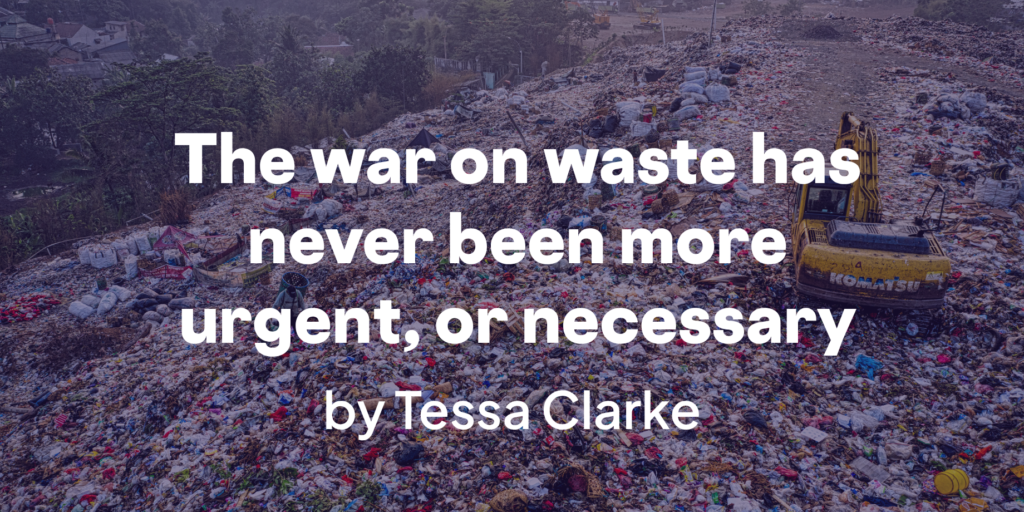
The war on waste has never been more urgent. And, at last, it’s never been more fashionable either.