For Food Waste Action Week, Olio surveyed 1,614 of our app users about their thoughts, feelings and attitudes around household food waste. This blog explains what they told us, and our take on why it matters.
Every year, Food Waste Action Week shines a light on one of the most pressing problems faced by our society today.
At Olio, we’ve spent the last 10 years building an amazing community of 5 million people living in the UK – most of whom hate throwing anything away. This year, we wanted to paint a more nuanced picture of how those households really feel about the issue of food waste.
Via a survey completed by 1,614 people, we dug into what happens with food waste in the home, and why: the feelings, the habits, the barriers, and the changes people actually want to see.
From the answers we gathered, it’s clear that food waste is a complex problem – and one that’s not always easy to avoid. But the appetite for change – at home, in supermarkets, and across the system – has never been stronger.
1. Even people who care deeply about food waste struggle to avoid it
The most striking finding from our survey is the gap between intention and reality.
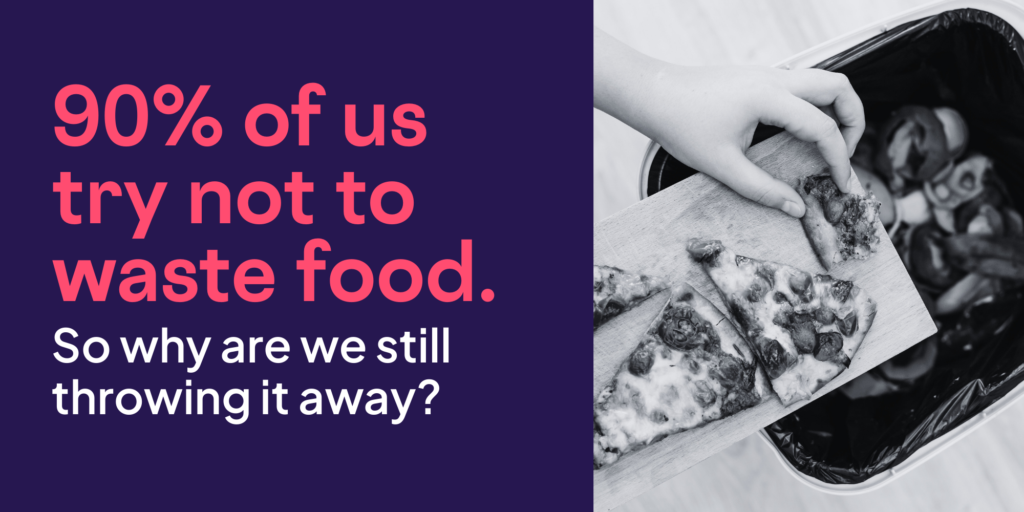
9 in 10 respondents say they actively try to avoid wasting food. And yet only 18% reported throwing away nothing at all in the previous seven days. A further 40% said they wasted a small amount, and 6% a moderate or large amount.
90% of respondents actively try to avoid wasting food – yet most still waste some every week
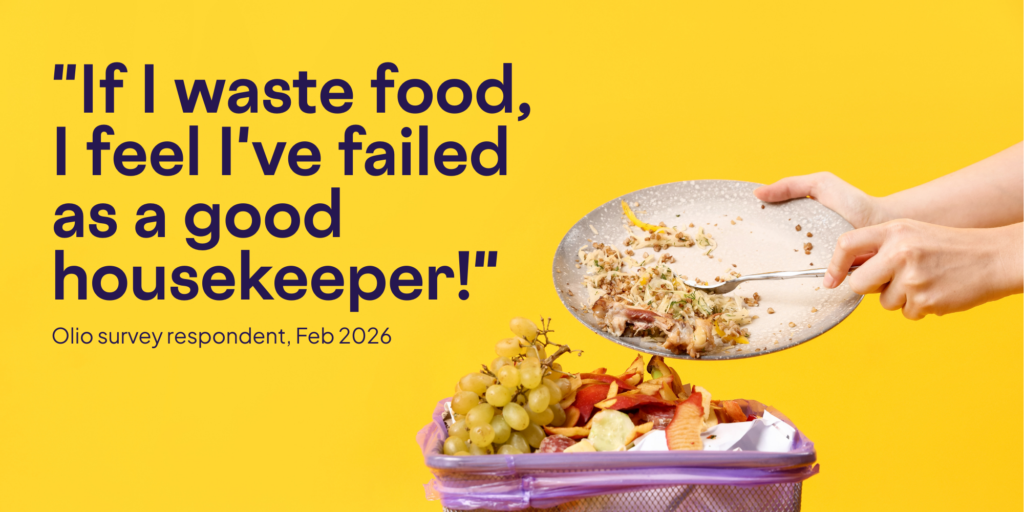
Throwing food in the bin isn’t something people do lightly – in most cases, they feel this deeply. When asked how wasting food makes them feel, guilt was the most common response (cited by 53% of respondents), followed by regret about money (49%), frustration (44%), worry about the environment (38%), and shame (27%).
Food waste is not a values problem – among Olio’s user base, people care enormously. They told us that for them, food waste happens more as a result of current systems and habits. The conditions of everyday life – busy schedules, large pack sizes, and confusing labels – make waste almost inevitable, even for those trying hard to prevent it.
2. What’s actually getting thrown away – and why
Fresh fruit, vegetables and salads top the list of most commonly wasted food (29%), followed by bread and bakery items (18%), and cooked leftovers (10%). These are all perishable, and often bought in quantities that don’t match how we actually eat.
When we asked what situations most often lead to waste, the picture became clearer. The hardest situations to avoid were:
- Food going off before it’s used (23%)
- Not eating food in time (22%)
- Cooking too much or over-catering for guests (8% each)
- Change in diet or preferences, including children changing their minds (8%)
- Change of plans – ordering a takeaway instead (7%)
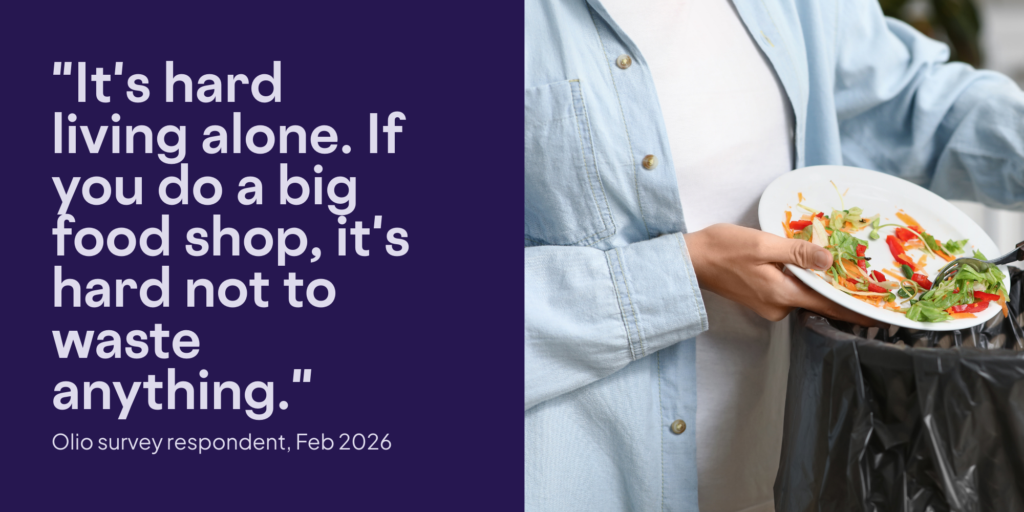
These results point to some of the structural changes that would make the biggest difference: smaller pack sizes (especially for people living alone), more loose fruit and veg options, and better meal planning support.
3. The date label problem is real – but nuanced
Date labels remain one of the most misunderstood aspects of food at home. Our survey revealed a complex picture.
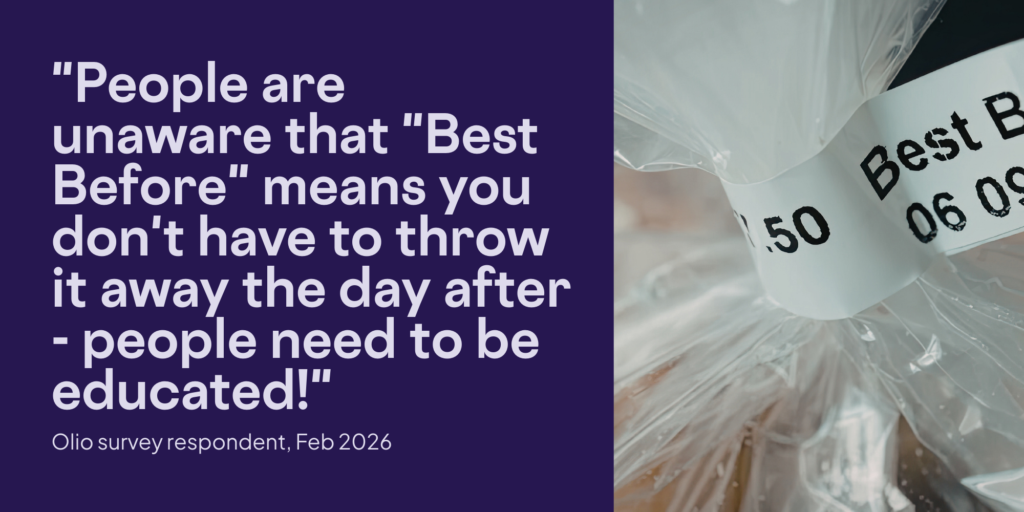
On one hand, knowledge among the Olio community is relatively high: 73% correctly identified that Best Before relates to quality, while Use By relates to safety. Average confidence in understanding the difference was 6.5 out of 7. That’s unsurprising considering many of our users will be Food Waste Hero volunteers, and will have learnt this during their food safety training with us.
6.5 / 7 is the average confidence level for understanding Best Before vs Use By – yet many still wait for food to visibly go off
But when asked whether waiting until food has visibly gone off makes it feel easier to throw away, 19% said yes, and a further 14% said sometimes. People are using visible deterioration as their cue to act.
4. The changes people actually want
We asked respondents to rate the helpfulness of ten potential changes, then choose the single one that would make the biggest personal difference. The results were unambiguous.
The top single change, by a significant margin, was more loose and unpackaged options in shops, chosen by 28% of respondents. A further 13% said smaller pack sizes, reflecting the challenge of buying appropriate quantities for smaller households.
28% said more loose / unpackaged options in shops would make the single biggest difference to their food waste
Removing Best Before dates entirely was chosen by 11% – showing that many people believe structural, systemic changes within supermarkets would help enormously.
It’s also worth noting what people didn’t prioritise. Removing Use By dates was notably unpopular – people clearly value safety guidance. The appetite for change is focused on quantity, packaging, and education.
5. Retailers are being watched – and judged
One of the clearest findings from our survey is the commercial case for retailers taking visible action on food waste.
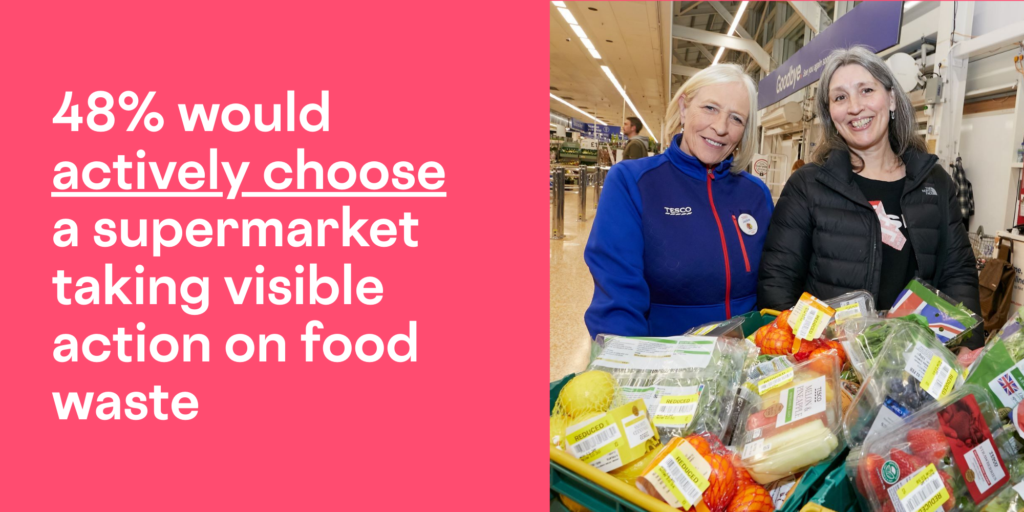
48% would actively choose a supermarket taking visible action on food waste, with a further 23% saying it would probably or might influence their decision
Among those who answered this question, when asked how visible action would influence their choice between two similarly priced and convenient supermarkets:
- 48% said they would choose the one taking visible action on food waste
- A further 23% said it would probably or might influence their choice
- Only 7% said it wouldn’t influence their choice at all
And when people see a retailer taking action, the emotional response is strongly positive. 58% said it feels like the retailer is doing the right thing, 49% felt more positive about the brand, and 31% said they’d be more likely to trust them*. The greenwashing concern – ‘feels like marketing rather than real change’ – was cited by 7%, a real risk if actions aren’t substantive.
“When supermarkets fill bins with perfectly good food, it’s quite disheartening to see.”
*These percentages are based on respondents multi-selecting answers to the question, which is why they don’t add up to a round 100%
6. Olio’s role: filling the gap between surplus and waste
Olio exists precisely at the intersection of the problems this survey describes. Among users who share food via the app, the data is striking.
55% of people who share food on Olio say their food would probably have been thrown away without the app
When asked what would have happened to shared food without Olio, 55% said it would probably be thrown away. A further 14% were unsure.
The benefits go beyond reducing waste. The most commonly cited use of Olio was meeting neighbours and building community (44% of respondents), followed by handling unexpected surplus (40%) and avoiding the guilt of throwing food away (37%).”
Two thirds of Olio users (67%) rate the app 6 or 7 out of 7 for importance in helping them reduce food waste – a signal of how it’s become part of their their everyday habits.
7. The £1,000 figure: motivating, but not the whole story
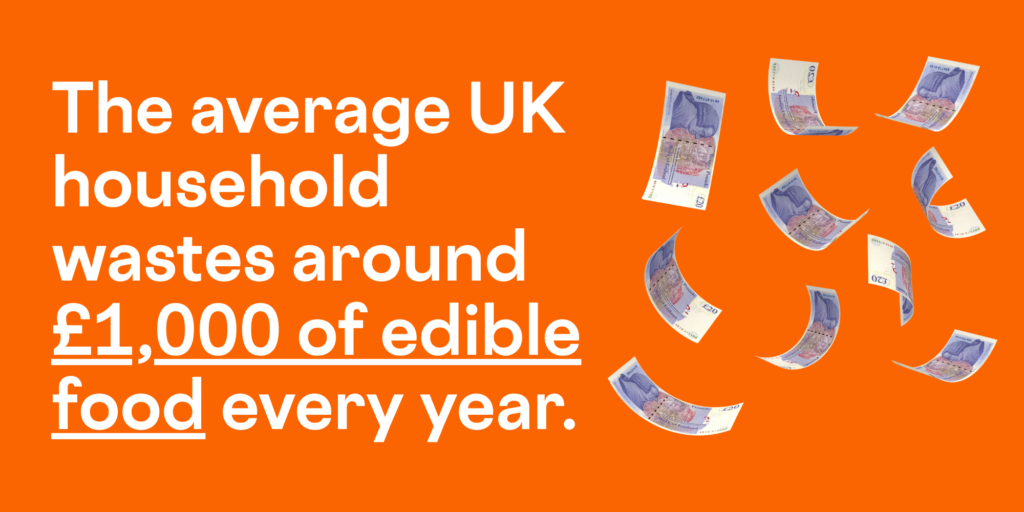
Among respondents who were shown this £1,000 figure, 36% said it would motivate them a lot and a further 16% said a little – a combined 52% finding this genuinely motivating.
52% said knowing households waste £1,000 of food a year would motivate them to reduce their own waste
But 8% said ‘not at all’, and the open comments reveal why. Many who already waste little feel the figure doesn’t apply to them. Others are frustrated that the conversation keeps focusing on individual households while supermarkets continue to over-order and over-produce.
This reflects a broader sentiment: people believe their own household waste is relatively contained, but they are angry about systemic waste further up the supply chain. When asked where most food waste happens in the UK, 50% pointed to retail – far more than the 25% who pointed to households.
8. The big picture: optimism, with conditions
85% believe the UK can realistically halve household food waste*
(Yes + Maybe combined)
Despite the scale of the challenge, our survey reveals genuine optimism. When asked whether the UK can realistically halve household food waste, 53% said yes and 32% said maybe. Only 9% said no.
But this optimism is conditional. Respondents consistently indicated that change needs to come from multiple directions simultaneously. When asked how willing they would be to change habits if government, retailers and brands made it easier, 49% gave the maximum score of 7 out of 7, with an average of 5.96 out of 7 across all respondents.
What this means for Olio
These findings confirm what Olio has always believed: food waste is a collective problem that requires collective solutions.
The emotional weight people carry – the guilt, the frustration, the shame – deserves to be matched by practical infrastructure that makes doing the right thing easy.
Olio exists at the intersection of everything this survey points to: community connection, local surplus sharing, reducing the friction between excess food and people who can use it.
The 1,614 people who took part are telling us that the will is there. Now it’s time to make the system match 💪
About this survey
Olio conducted this survey across five audience segments – Food Requesters, Food Adders (adding their own food), Non-food Adders & Requesters, Food Adders & Requesters, and Food Waste Heroes (adding food from businesses) – collecting 1,614 responses from app users across the UK.
Respondents skewed towards people who actively engage with food waste issues, meaning these findings likely reflect a higher level of awareness and motivation than the general population. The survey was conducted in February 2026.
olioapp.com